OpenAI product manager interview: what OpenAI publishes
Updated 5 min read
OpenAI publishes an interview guide that is general, not written for product managers. It lists five stages as an example, plus a note on how interviews work, and final interviews typically take 4 to 6 hours. We found no page on openai.com about product manager interviews in particular, so we would practice AI product questions first, then behavioral answers.
What OpenAI says about its interviews
- The guide is general, not written for product managers. It calls its steps an example, and it says your own experience may differ. Interview guide
- OpenAI says it wants experts, and also people with high potential who have not specialized yet: those who have shown they can learn a new area fast and get results. It says it is not driven by credentials. It cares about collaboration, clear communication, taking feedback well, and agreement with its mission and values. Interview guide
- The introductory calls are with a recruiter or the hiring manager. Come ready to talk about your work and studies, your motivations and your goals. OpenAI recommends that you get to know its recent updates, above all the ones tied to the team that is interviewing you. Interview guide
- Next is a skills-based assessment. The format varies by team. The page says it may include pair coding, take-home projects or technical tests, among others. Depending on the role, there may be more than one. Interview guide
- The interviews are built to show how you work through a problem, how you decide, and how you explain your thinking. Interview guide
- The rules on AI tools differ from one interview to the next. Some formats allow them on purpose, and others test how you solve problems without them. Your preparation materials say which applies. If unsure, check with your recruiter first. Interview guide
- Final interviews are virtual by default, and you may choose to do them at the San Francisco office. They focus on your own field, and the guide calls them "designed to stretch you beyond your comfort zone". Interview guide
- For general reading, the guide recommends the OpenAI Charter, plus any of OpenAI's blog posts and research publications you find interesting. Interview guide
- Where the guide mentions values, it links to the careers page, which is about the company and not about interviews. It lists four values: Humanity first, Act with humility, Feel the AGI and Ship joy. It also lists four operating principles for how staff work together: Find a way, Creativity over control, Update quickly and Intense focus. Careers
- A posting we read on 15 Nov 2026 says the role suits a PM who is strong technically, at ease with unclear problems and structured in product thinking. This is one role, not an interview format. Product Manager, API Agents
- A second posting, read the same day, says you might do well in that one role if you can turn a vague question about policy or threats into requirements, metrics and trade-offs. Product Manager, Integrity
We read these pages on 15 Nov 2026. A company can change its process at any time, so read them again before your interview.
PMInterviewKit is not affiliated with OpenAI.
The steps, in order
This is the guide's example, not written for product managers.
- Application. You apply, and the recruiting team typically takes one week to read your résumé and reply.
- Introductory calls. If there may be a fit, you talk with a recruiter or the hiring manager.
- Skills-based assessment. The recruiting team tells you within a week if you have moved to the next stage, and you get an answer within a week once the assessment is done.
- Final interviews. Typically 4 to 6 hours of interviews with 4 to 6 people, spread across 1 to 2 days.
- Decision. Expect an answer within one week of the final interviews, and your recruiter may ask you for references.
- Application
- Introductory calls
- Skills-based assessment
- Final interviews
- Decision
Which rounds to practice
| What OpenAI's pages say | Round to practice | Start here |
|---|---|---|
| General reading it recommends: the Charter, plus blog posts and research publications you find interesting. For the introductory calls, it recommends knowing its recent updates (guide, general) | AI product | AI product questions |
| Interviews show how you work through a problem, decide and explain your thinking (guide, general) | Product sense | Product sense questions |
| Talk about your work, motivations and goals. Collaboration, communication and taking feedback matter (guide, general) | Behavioral | Behavioral questions |
| A PM who is strong technically (one posting, API agents) | Technical | Technical questions |
| Turning a vague question into requirements, metrics and trade-offs (one posting, Integrity) | Metrics | Metrics questions |
The match between OpenAI's words and these rounds is ours, not OpenAI's.
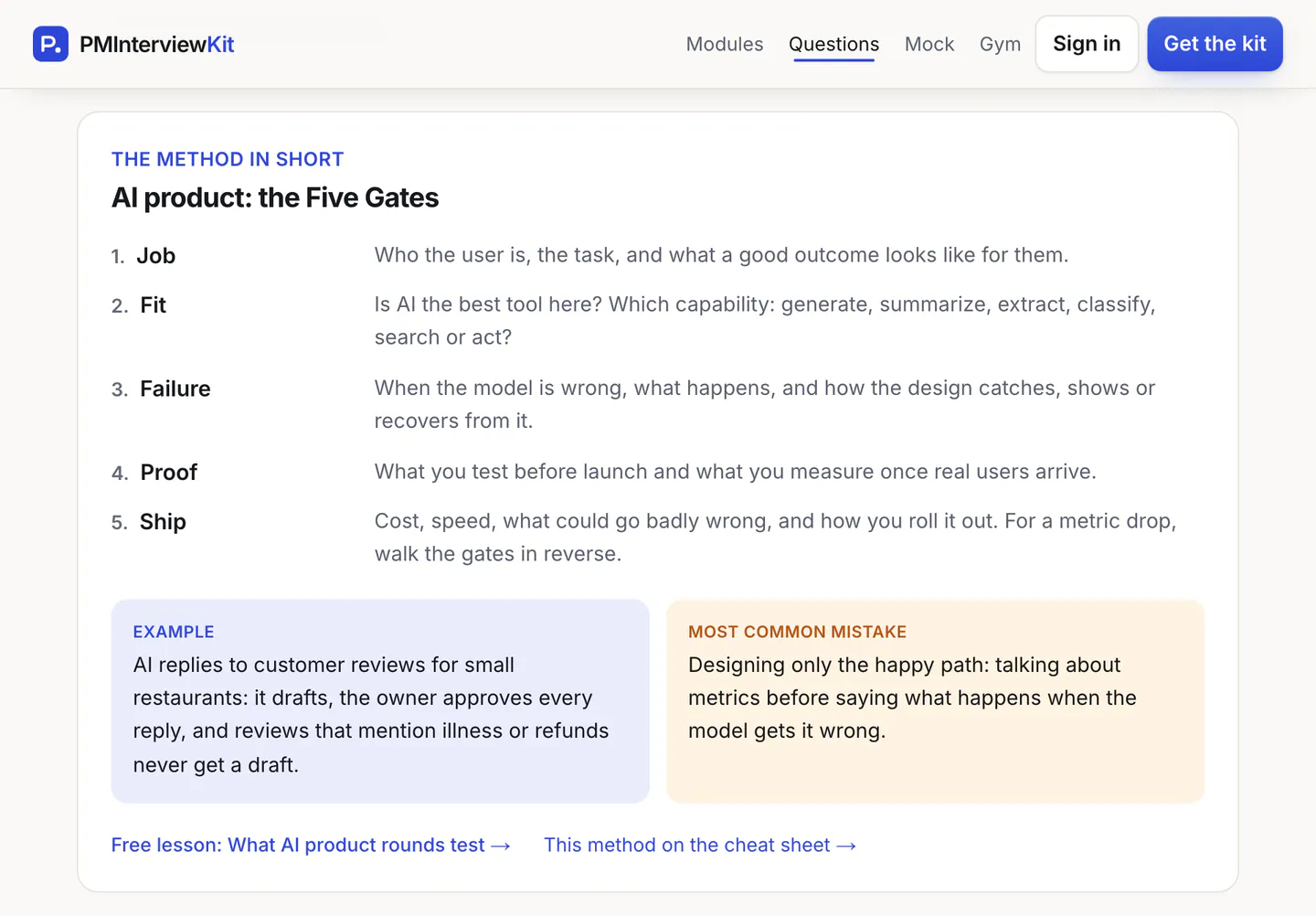
We would practice AI product questions first, because the guide recommends knowing OpenAI's recent updates. That choice is our judgment.
Questions to practice
These are practice questions from our free bank. They are not questions OpenAI has said it asks.
AI product
- Explain how a large language model works to a non-technical executive.
- How would you evaluate whether an AI summarization feature in an email app is good enough to launch?
- When should a product not use AI?
Product sense
Behavioral
- Why do you want to work here, and why now?
- Tell me about a time you received critical feedback.
- Tell me about a time you had to learn something new very quickly.
Metrics
A plan for the last two weeks
- Take the readiness quiz. It has 14 questions and takes about six minutes.
- Follow the 14-day plan it gives you. This post explains how the plan works.
- Keep the cheat sheet open while you practice. It has each round's method on one page, with no sign-up.
- Near the end, try a mock interview with Ava. The first one is free with an email address.
What OpenAI does not publish
- We looked for a page about product manager interviews on openai.com and did not find one. The only role the guide gives interview criteria for is engineering.
- We did not find what the skills-based assessment is for a product manager.
- We did not find what each final interview covers.
- We did not find which interviews allow AI tools. Neither posting we read describes its interviews.
Next step
Start with the AI product questions, and answer the first one out loud today.