Which round should you study first? The readiness quiz
Updated 5 min read
Study your weakest round first. The readiness quiz finds it in about six minutes. You answer 14 questions, and you get a gap map of seven interview rounds and a 14-day plan that starts with the round you got wrong. It is free and needs no sign-up.
What the quiz asks
The quiz has two questions for each of seven rounds:
- Product sense
- Metrics and execution
- Estimation
- Behavioral
- Strategy
- Technical
- AI product
Each question describes a moment from an interview and asks for the strongest move. It might be the best first question to ask, the metric that fits, or the right reply when the interviewer disagrees with you. You choose one answer from a short list.
After each question you see the recommended answer and the reason for it. So you learn something from every question, including the ones you got wrong.
You do not need to know the name of any method. The questions test judgment: what a strong candidate would do next.
How long it takes, and where your answers go
The quiz takes about six minutes. It runs in your browser, and your answers are never sent to us.
Your browser saves three things: your score for each round, the day you took the quiz, and the plan days you have ticked. That is why your plan is still there when you come back to the page on the same browser. You can delete the saved plan from the result page.
If your browser does not let the page save, the page tells you. In that case keep the tab open, or print the page.
The gap map
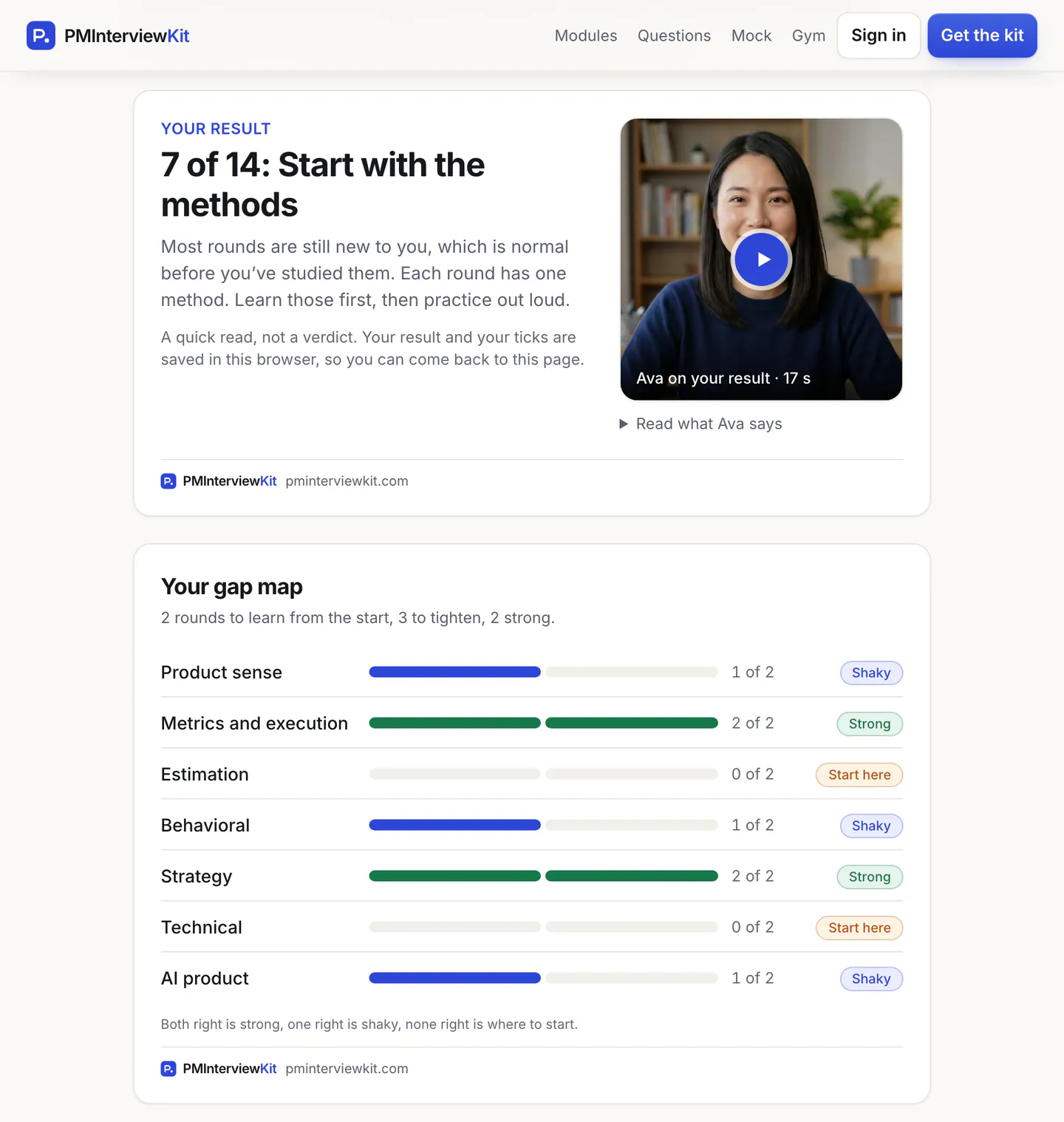
Your result starts with a total out of 14 and a short reading of it. There are three readings: your judgment is in good shape, you are close with a few rounds to fix, or you should start with the methods.
Under that is the gap map. It shows all seven rounds side by side, each with one of three marks:
| Mark | What it means |
|---|---|
| Strong | Both questions right |
| Shaky | One question right |
| Start here | No questions right |
Two questions for a round is a quick read, not a verdict. A "Strong" mark does not mean the round is finished, and a "Start here" mark does not mean you are bad at it. Use the map for one decision only: what to study first.
The 14-day plan
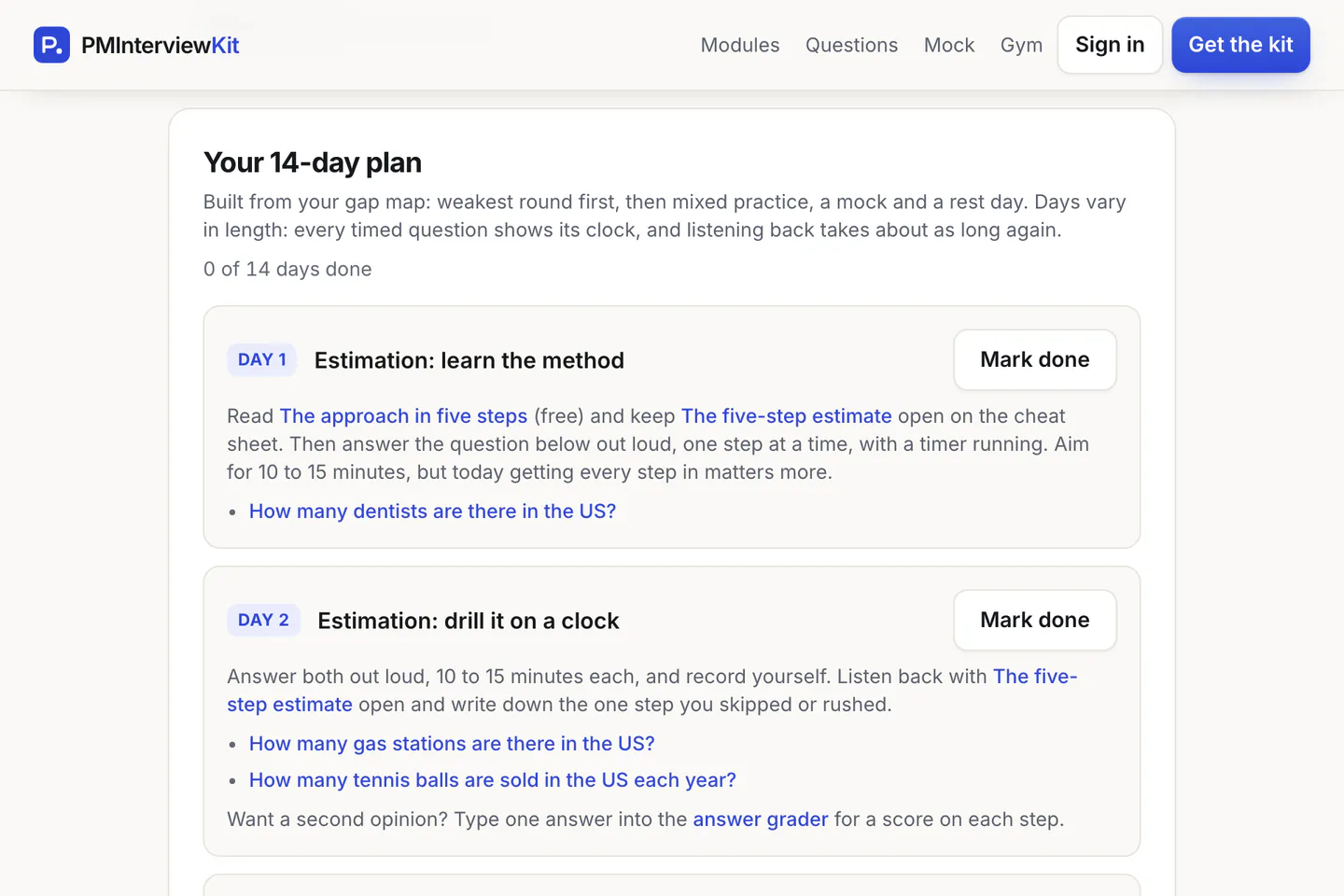
The plan is built from your gap map. The days depend on your result, but the shape is always the same.
Days 1 to 11: one round a day, weakest first. Every round gets at least one day.
- A round that was not strong starts with a day to learn its method. That day links the round's free lesson and its card on the cheat sheet, and gives you one question to answer out loud.
- The spare days go to your weak rounds as drill days. On a drill day you answer two questions on a clock and record yourself. A weak round can have up to two drill days.
- A round you were strong in gets one day to keep it warm, with one harder question.
Day 12: mixed practice. Questions from three rounds, one after the other, each on its own clock.
Day 13: a mock interview. Three full answers across three rounds, weakest first. You run it yourself: timer on, paper for notes, nothing else open, recorded. If a friend can read the questions to you, that is better.
Day 14: review, then rest.
14 days, in four parts
- Days 1 to 11: One round a day, weakest first
- Day 12: Mixed practice
- Day 13: A mock interview
- Day 14: Review, then rest
Each practice day links the exact questions to answer, from the free question bank, and shows the clock for the round. You tick each day when it is done.
How to act on your result
Do day 1 today. Read the free lesson for your weakest round, keep its card on the cheat sheet open, and answer the day's question out loud. Aim to get every step of the method in. Speed comes later.
Tell the plan when your interview is. Under the plan you choose one of three timelines, and the page tells you how to pace the 14 days:
- Within a week. Do two plan days on each calendar day for six days, then the mock and its review on the seventh. If a day is too heavy, drop the "keep it warm" days first. Keep the mock.
- In 2 to 4 weeks. Run the 14 days. Then repeat days 12 to 14 each week with new questions until the interview, or move to the 30-day plan.
- Later, or no date yet. Take a plan day every two or three days.
Keep your strong rounds warm. A round you were strong in gets one day with one harder question. Do it unless you are short of time.
Answer out loud, not in your head. The quiz tests judgment with a short list of answers. An interview asks you to say a full answer, on a clock. The plan's questions are there to practice that. If you want a score for a spoken answer, you can try a mock interview with Ava. Your first one is free.
Take the quiz again after you practice. When you have worked on your lowest round, take the quiz again and see whether the map changed. Finishing a new attempt replaces your saved plan and its ticks, so finish the plan you are on first if you want to keep your ticks.
What the plan uses, and what the kit adds
Everything the 14-day plan links is free: the first lesson of each round, the cheat sheet and the question bank.
The full kit has more for each round. After the free first lesson, a module has more lessons on its method, and worked answers written out in full. There are 88 lessons and 66 worked answers and cases in all. You can see what is in it on the full kit page.
Next step
Take the readiness quiz now. Then do day 1 of your plan before you close the page.