How to practice with the 200 free PM interview questions
Updated 5 min read
Say your answer out loud before you open the outline. That one rule turns the question bank from reading into practice. Every question page is built for it: the first move is always in view, and the outline stays closed until you open it.
What each question page gives you
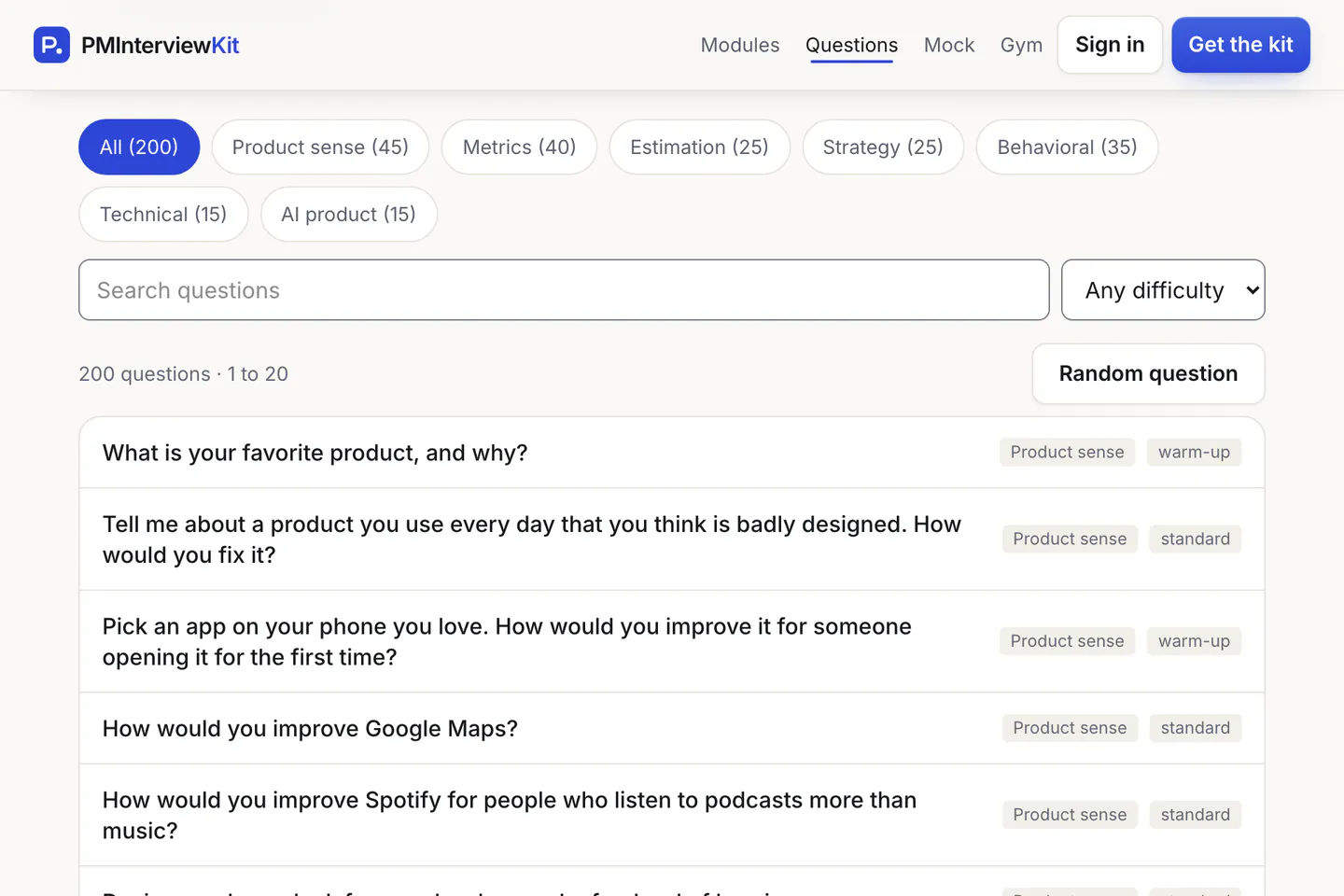
The question bank has 200 questions and all of them are free. Each question has its own page with:
- The round and the difficulty. The difficulty is warm-up, standard or stretch.
- How to approach it. This is the first move: one or two sentences on where to begin. It is always open.
- A 2-minute think timer. Use it to plan your structure before you speak.
- Three closed sections. They are "How a strong answer opens", "Outline of a strong answer" and "Where this question usually goes wrong". Open them after your own attempt.
- A "Mark practiced" button. A tick then shows beside that question in the list. Your ticks are saved in your browser, and on your account if you are signed in.
- Previous and next. These move through the questions of the same round.
Pick questions by round
Practice one round at a time until you know its method. Each round has its own page:
- Product sense: 45 questions
- Metrics: 40 questions
- Behavioral: 35 questions
- Estimation: 25 questions
- Strategy: 25 questions
- Technical: 15 questions
- AI product: 15 questions
200 free questions in 7 rounds
- Product sense45
- Metrics40
- Behavioral35
- Estimation25
- Strategy25
- Technical15
- AI product15
A round page shows what the interviewer is scoring, the round's method in short, the most common mistake, and the questions grouped by difficulty. If a round is new to you, start with the warm-ups.
On the main list you can filter by round and by difficulty, or search for a word. The "Random question" button picks a question for you, and it picks ones you have not marked as practiced first. Use it. If you look through several questions and choose the one you like, you practice only what you already know.
If you do not know which round to start with, the readiness quiz shows your weakest one in about six minutes.
One question, step by step
- Read the question and the first move. Nothing else yet.
- Start the 2-minute think timer. Write your structure on paper, as you would in the room.
- Answer out loud, on a clock. Record yourself on your phone. Use the clock for the round from the table below.
- Open the outline and compare. Go step by step. Mark each step you covered and each step you skipped.
- Open the other two sections. Read how a strong answer opens and where this question usually goes wrong. Check whether you made that mistake.
- Write down one thing to change. Then press "Mark practiced".
| Round | Time for one answer |
|---|---|
| Product sense | 25 to 30 minutes |
| Metrics | 20 to 25 minutes |
| Strategy | 20 to 25 minutes |
| Technical or AI product | 20 to 25 minutes |
| Estimation | 10 to 15 minutes |
| Behavioral | 2 to 3 minutes for each story |
These are practice targets, not any company's rule.
How many questions a day
One long question a day is enough. A product sense answer takes about 25 minutes, and the review takes about 12 more. With a few minutes to pick the question and write your notes, that is a 45-minute session.
A 45-minute session
- 8 minutesPick the question, write notes
- 25 minutesAnswer out loud, on a clock
- 12 minutesReview the same day
For estimation and behavioral, answer two or three questions in a session, because each one is short.
When you plan your weeks, allow about ten reviewed answers for each round. This is a rough guide for planning and not a research finding. Some rounds will need more.
Two more rules help the practice last:
- Spread it out. Three product sense answers on three different days teach more than three on one day.
- Mix the rounds later. Once you know each method, take questions from different rounds in one session. On a real interview day the round changes from one interview to the next, and you have to choose the right method yourself.
How to review an answer
The review is where you learn what to change. An answer you do not review is mostly wasted.
- Listen back within the hour. You still remember what you meant, so you can compare it with what you said.
- Write down your own words. "I listed four users and never picked one" is useful. "Structure was weak" is not.
- Choose one fix. Write it at the top of your next session, and judge that session on the one fix.
- Answer the same question again a day later. The second try shows whether the fix worked.
- Keep a short log. Write the date, the question, the round and the one thing to fix. Read the log once a week. You will see which mistake keeps coming back and which round you have been avoiding.
Three more ways to use the same questions
- Watch one answered. The question bank has 21 short mock interviews on video, three for each round. Ava asks a question from the bank and Grace answers it twice: a first try, then Ava says what is missing, then a stronger answer with its scorecard. Answer the question yourself first, because the video shows a strong answer.
- Answer one with Ava. Ava asks 184 of the 200 questions in the mock interview. You answer out loud or type, and you get a score for each step of the round's method. Your first one is free.
- Read the method first. The cheat sheet has the method for each round on one page, so you know which steps the outline will follow.
An outline shows the steps of a strong answer, not the full answer. The full kit has 66 worked answers and cases written out from start to finish. You can see what is in it on the full kit page.
Next step
Open the question bank, filter to one round, and press "Random question". Then answer it out loud before you open anything.