How a mock interview with Ava works: reading your scorecard
Updated 5 min read
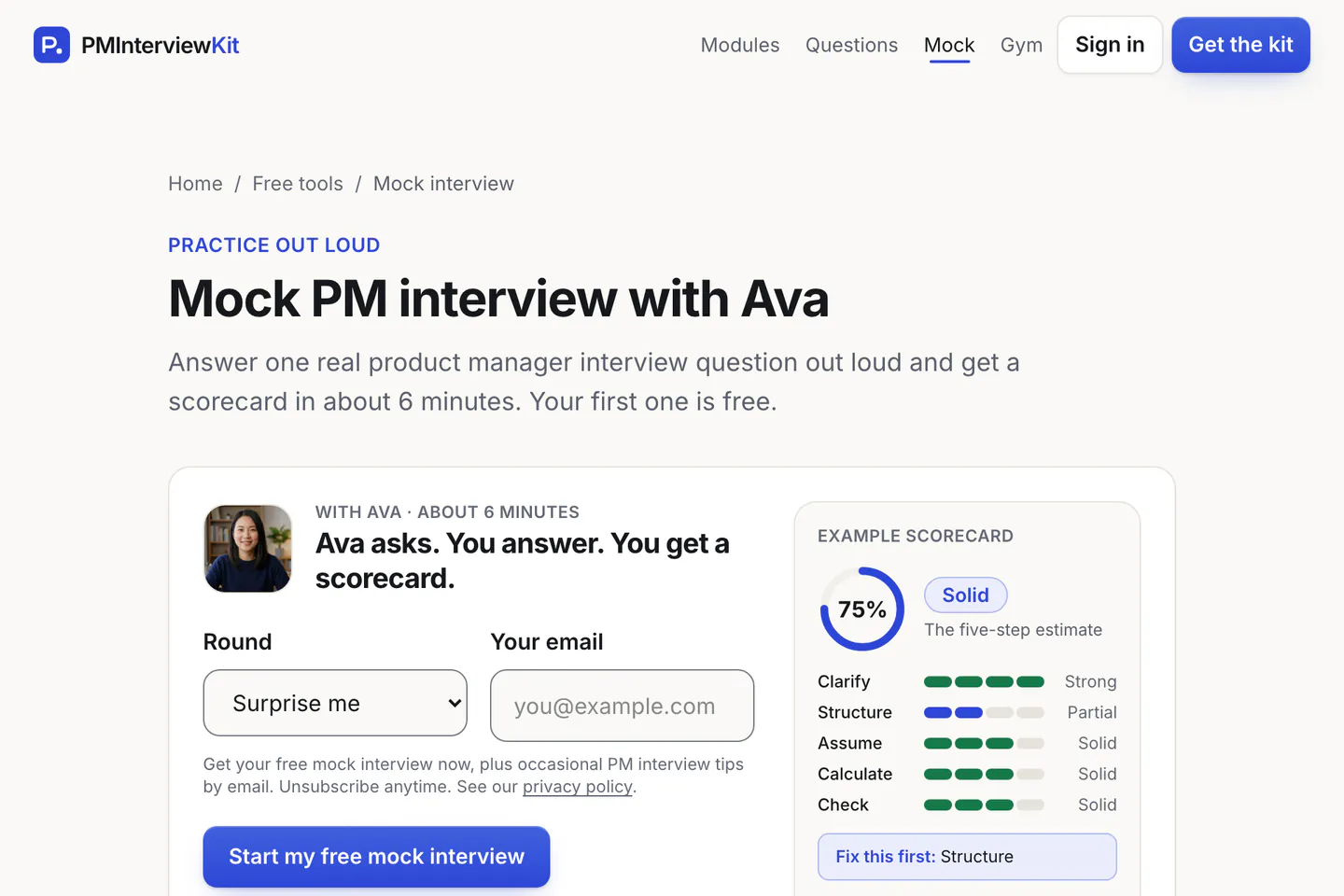
A mock interview with Ava is one real PM interview question, your answer out loud, and a scorecard. It takes about six minutes, and your first one is free with an email address. The most useful part comes at the end: the scorecard names one thing to fix first, and you can answer the same question again for free while it is fresh.
What happens, step by step
- Choose a round. On the mock interview page you pick product sense, metrics, estimation, strategy, behavioral, technical or AI product. You can also pick "Surprise me" for a question from any round.
- Ava asks the question. She has 184 questions from the free question bank and picks one at random from your round. You can play her clip, and her words are always shown as text too.
- You see what you will be scored on. Under the question the page names the round's method and lists its steps. For an estimation question the steps are Clarify, Structure, Assume, Calculate and Check.
- You answer. Say your answer or type it. Two to three minutes of speaking is about right.
- You press "Grade my answer". Scoring takes about ten seconds.
- You read the scorecard. Then you try the same question again, or move on to the next one.
- Choose a round
- Ava asks the question
- You see what you will be scored on
- You answer
- You press "Grade my answer"
- You read the scorecard
Then back to step 4: the same question again, with one fix in mind.
Ava's clips are recorded in advance. She does not listen live and she does not ask follow-up questions.
Speaking or typing
The answer box has a mic at its edge. Tap it and talk. Your browser turns your voice into text and writes it into the box. When you stop the mic, you can correct the text before you grade it.
Some facts that help:
- Nothing is recorded. No audio is sent to us. Only the text of your answer is graded, and we do not store that text. We keep your email address or account, which question you answered and when, and how many mock interviews you have used. The questions at the bottom of the mock interview page say which services handle your voice and your text.
- The mic needs the right browser. Safari, Chrome and Edge have their own speech recognition. Firefox does not, and the browsers built into some apps do not. If you see no mic, open the page in Safari or Chrome.
- You have three minutes of speaking. After that the mic turns itself off. You can still type and edit.
- Typing is scored the same way. On a phone, the microphone key on the keyboard can also write the answer for you.
- An answer needs at least 40 words. A shorter one is a note, not an answer, and cannot be graded.
We suggest speaking if you can. A real interview is spoken, and saying an answer shows gaps that typing hides.
How to read your scorecard
Read it from the top down.
The total. Your score is a percentage with a level: Early is under 40, Developing is 40 to 59, Solid is 60 to 79 and Strong is 80 or more. Beside it you see the points you earned out of the points possible.
Ava's verdict. Ava gives a short verdict for your score range. It says what the range means. It is not a promise about a real interview.
What you did best. One line on the strongest part of your answer. Keep doing it.
Fix this first. This is the most important box on the page. It names the one change that would help your answer most, says why an interviewer cares, and shows what a stronger answer would have said. Start here.
Step by step. Every step of the round's method gets a score from 0 to 4: Missing, Weak, Partial, Solid or Strong. Each step also gets one sentence about your answer. The total is the share of points you earned. A method with five steps has 20 points, so 12 points is 60 percent.
Example: five steps, 20 points
- Clarify3 Solid
- Structure3 Solid
- Assume2 Partial
- Calculate2 Partial
- Check2 Partial
12 of 20 points is 60 percent: Solid.
- Early: under 40
- Developing: 40 to 59
- Solid: 60 to 79
- Strong: 80 or more
More fixes. Up to two more fixes follow, in order of value. Leave them until the first one is done.
At the bottom there is a link to the free lesson that teaches the method you were scored on.
What the score can and cannot tell you
An AI model reads the text of your answer and scores it against the round's method. That means three things:
- It scores your words. It cannot hear your pace, your tone or your confidence.
- It can misjudge an unusual answer.
- It checks one answer to one question. It does not tell you how a real interview will go.
Use the score to decide what to practice next. A low score on a first try is common. It means steps of the method were missing, and the steps can be learned.
The free second try
Pressing "Grade my answer" is the only thing that uses up a mock interview. Speaking, typing and editing do not.
If you answer the same question again within 60 minutes of your last graded try, the second try is free. The button under the first fix says "Try this question again (free)". When you press it:
- The page shows the fix to work on above the answer box.
- You answer again, with that one fix in mind.
- The new scorecard shows how your score moved since the last try.
We think this is the best way to use a mock interview: one question, answered twice, with one fix between the two tries.
When you are ready and have a mock interview left, "Next question" gives you a new question.
What is free and what comes with the kit
- Free: one mock interview for an email address, and the free second try on the same question. We also send occasional PM interview tips to that address, and you can unsubscribe at any time.
- With the full kit: 20 mock interviews with Ava. If you bought the kit, sign in to use them. The kit also has the lessons behind every step you are scored on. You can see what is in it on the full kit page.
The methods are free to read. The cheat sheet has every round's method on one page. Read your round's card before you start, and you will know what the scorecard looks for.
Next step
Start your free mock interview. Pick the round you find hardest, and plan to answer the question twice.